In Greece, Easter is not a single meal but the payoff of a season-long rhythm of restraint and release. For forty days beforehand, kitchens across the country quietly shift toward plant-based cooking, and then, over the span of about eighteen hours, everything changes: a midnight soup breaks the fast, a whole lamb turns slowly over coals, sweet braided bread appears on every table, and children go around cracking blood-red eggs against their cousins' knuckles. None of it happens by accident. Each dish, each gesture, is doing quiet theological work, standing in for resurrection, sacrifice, or the plain relief of a fast finally ending. What makes Greek Easter food so distinctive is how tightly it's stitched to the church calendar. You can't really understand why mageiritsa tastes the way it does, or why lamb is roasted whole instead of carved into chops, without understanding the fast that precedes it and the midnight service that ends it. This guide walks through that arc in order: the long lead-up of Lent, the midnight soup that breaks it, the Sunday lamb that headlines it, and the breads, eggs, and cookies that surround it. Together they form one of the most food-centered religious calendars anywhere in the Mediterranean.
Forty Days of Restraint: The Lenten Fast
Greek Orthodox Easter, or Pascha, is preceded by Great Lent, a forty-day fasting period that begins on Clean Monday (Kathara Deftera) and runs through the eve of Holy Saturday. Observant households cut out meat, dairy, eggs, and, on the strictest days, olive oil and wine, leaving a diet built around vegetables, legumes, grains, and, notably, shellfish and other bloodless seafood, which the fasting rules don't classify alongside fish and meat.
The point isn't deprivation for its own sake. In Orthodox teaching, fasting is a tool for reining in appetite and impulse more broadly, a way of practicing self-discipline that's meant to sharpen focus on prayer and reflection rather than punish the body. That said, the effect on Greek cuisine has been enormous and enduring: an entire repertoire of hearty, satisfying "nistisima" (fasting) dishes has developed over centuries, from bean soups and stewed greens to olive-oil-free flatbreads, precisely because people needed food that felt substantial without breaking the rules.
The fast tightens further during Holy Week, the seven days leading up to Pascha, with Good Friday typically kept as a day of especially strict abstinence in mourning for the Crucifixion. By the time Holy Saturday arrives, most fasting households haven't eaten meat, dairy, or eggs in over a month and a half. That long runway is what makes the food of Easter weekend feel less like a menu and more like an arrival.
Midnight and Mageiritsa: Breaking the Fast
Just before midnight on Holy Saturday, Greeks gather at church for the Resurrection service, standing in darkness until the priest emerges with a lit candle and the chant "Christos Anesti" (Christ is risen) passes from flame to flame through the congregation. Fireworks and church bells usually follow. Families then carry their lit candles home, and it's here, at the table right after midnight, that the fast formally ends.
The dish that ends it is mageiritsa, a soup built from lamb offal, usually the liver, lungs, heart, and intestines, simmered with scallions, dill, and other greens, then finished with an egg-lemon (avgolemono) sauce. It's an unusual soup to plan a religious climax around, but the logic is practical as much as symbolic.
- The offal comes from the same lamb being kept for the Sunday roast; using the organs immediately avoids waste, in keeping with a broader thriftiness that runs through traditional Greek cooking.
- Organ meats spoil quickly, so cooking them the same day they're butchered isn't optional, which is part of why mageiritsa is tied so specifically to Holy Saturday rather than any other day of the weekend.
- The soup is gentle on a stomach that's been eating largely plant-based food for over a month, easing the body back onto meat and dairy before the richer feast that follows.
Recipes for mageiritsa vary considerably by region, some use only the lamb's head, others add tomato or mint, and a few island versions turn it into more of a stew with braided intestine, but the timing and purpose stay constant: it's the first bite of meat after Lent, eaten in the small hours of Easter morning.
The Easter Lamb on the Spit
If mageiritsa is the quiet opening note, the whole lamb roasted on a spit, known as souvla or ovelias, is the main event. On Easter Sunday, families and neighborhoods set up spits outdoors from early morning, often before sunrise, and take turns slowly turning a whole lamb (or, in some regions, goat) over charcoal for several hours until the skin crisps and the meat falls easily from the bone.
The symbolism draws directly from Christian imagery: Christ is referred to as the "Lamb of God" in the Gospels, and the animal's sacrifice is read as an echo of that theology, with the meal standing in for a sacrifice that, in Christian belief, no longer needs to be repeated. The custom also has older roots tracing back to the Passover lamb of the Jewish tradition, adopted into the Christian Easter narrative long before it became a Greek culinary fixture.
But ask most Greeks why they roast a lamb on Easter Sunday, and the answer tends to be less about theology and more about the day itself. Turning the spit is a group activity, cousins and neighbors rotate shifts, someone is always minding the fire, and the hours spent waiting for the meat to cook are as much the tradition as the meat itself. It's a communal meal built around a communal task, with music, wine, and conversation stretched out over most of the day.
It's worth noting the tradition isn't without controversy today; animal welfare advocates in Greece have criticized aspects of the mass slaughter and roasting that happens nationwide each spring, and some households now opt for smaller cuts or alternative centerpieces. Even so, the spit-roasted lamb remains the dominant image of Greek Easter Sunday, and the aroma of charcoal and roasting meat drifting through neighborhoods is, for many Greeks, simply what Easter smells like.
Tsoureki: The Sweet Bread of Resurrection
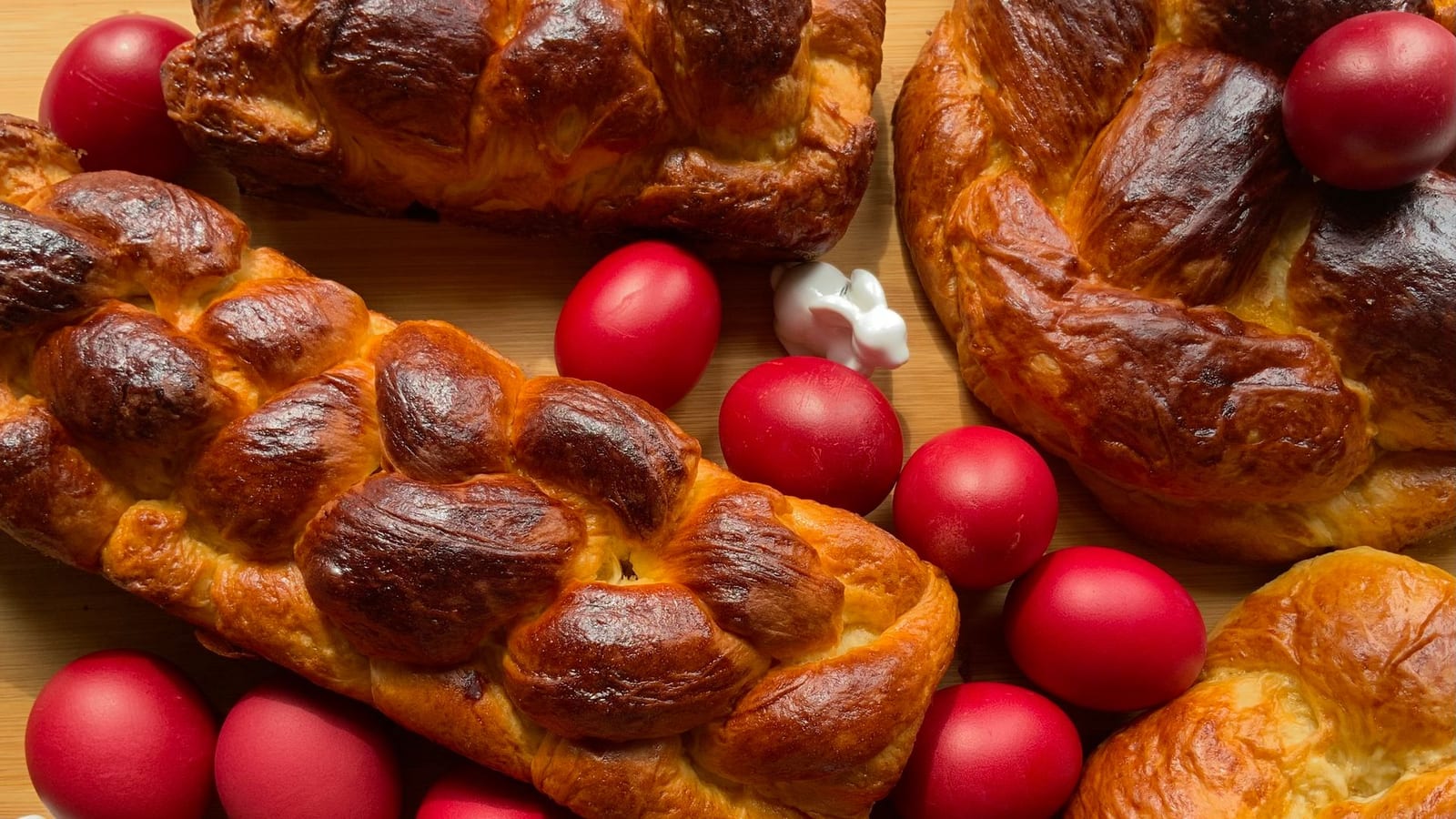
Tsoureki is the sweet, brioche-like braided bread that shows up on Greek tables from Holy Thursday through Easter Sunday, and its name actually comes from the Turkish "çörek," a legacy of centuries of shared culinary vocabulary in the region. Its ancestor, however, is older still: Byzantine-era breads called kollyrides were already being shaped specially and decorated with eggs for Easter long before the modern loaf took form.
The bread's rich dough, enriched with butter, milk, eggs, and often a distinctive spice blend of mahlepi and mastiha, rises noticeably during baking, and that visible transformation from flat dough to a tall, golden loaf is often read as a stand-in for resurrection and renewal, an apt metaphor for what the holiday itself is celebrating. The three-strand braid is sometimes tied to older folk beliefs about warding off misfortune, a shape carried forward long after its original meaning faded.
Most families bake tsoureki on Holy Thursday, tucking a whole red-dyed egg into the braid before baking so it sets into the loaf. That egg, and its color, isn't decorative flourish; it's doing the same symbolic work as the individually dyed eggs described below. Beyond the family table, tsoureki has also become a customary Easter gift, particularly one that godchildren bring to their godparents, keeping the bread tied to relationships as much as to ritual.
Red Eggs and Tsougrisma
Dyeing eggs a deep red is one of the oldest and most recognizable customs of Greek Easter, typically done on Holy Thursday alongside the tsoureki and koulourakia baking. The color stands for the blood of the Crucifixion, while the egg itself, hard-shelled and sealed, is read as a small model of Christ's tomb; cracking it open becomes a physical echo of the Resurrection breaking that seal. One popular legend credits Mary Magdalene with the custom's origin, telling of eggs in her basket turning red the moment she encountered the risen Christ.
The eggs aren't just eaten, they're played with. In the game known as tsougrisma, two people each hold a red egg and tap the pointed ends together, one calling out "Christos Anesti" (Christ is risen) and the other answering "Alithos Anesti" (Truly, He is risen). Whoever's egg survives without cracking moves on to challenge someone else, and tradition holds that the person left holding the last uncracked egg at the end of the round will have good luck for the rest of the year.
It's a simple game, low stakes and quick, but it turns Easter lunch into something interactive, with grandparents, parents, and children all lining up their eggs and trading blessings between cracks.
Koulourakia: The Easter Cookies
Rounding out the Holy Thursday baking marathon are koulourakia, butter cookies flavored with orange zest and vanilla, twisted or braided into small loops, S-shapes, or coils before baking to a golden, slightly crisp finish. Unlike mageiritsa or the lamb, koulourakia carry less explicit religious symbolism; their meaning comes more from being woven into the same day's rituals as the red eggs and tsoureki, and from being made together as a family.
- Shaping koulourakia is often a group task, with children pulled in to twist the dough alongside parents and grandmothers, making the cookies as much about kitchen time together as about the finished batch.
- They keep well and are baked in large quantities, meant to last through the rest of the Easter season and be offered to visitors dropping by over the following days.
- For many Greek kids, koulourakia are the first Easter treat they reach for, and usually the first to run out.
Taken together, the Holy Thursday trio of tsoureki, red eggs, and koulourakia marks the moment Easter moves from the church calendar into the home kitchen, setting the table, quite literally, for the midnight soup and Sunday lamb still to come.
Key Takeaways
- Greek Easter cooking follows the church calendar closely: a 40-day Lenten fast without meat, dairy, or eggs shapes what's eaten right up until Holy Saturday night.
- Mageiritsa, a lamb offal soup with egg-lemon sauce, is eaten just after the midnight Resurrection service and is the first meat consumed after Lent.
- A whole lamb roasted on a spit (souvla) is the centerpiece of Easter Sunday, prepared as a communal, hours-long outdoor cooking event rather than a quick meal.
- Tsoureki's braided, enriched dough and its rising during baking are traditionally read as symbols of resurrection, with a red egg often baked into the loaf.
- Red-dyed eggs represent Christ's blood and the sealed tomb; cracking them in the tsougrisma game symbolizes the Resurrection and is played as a good-luck ritual at the table.